

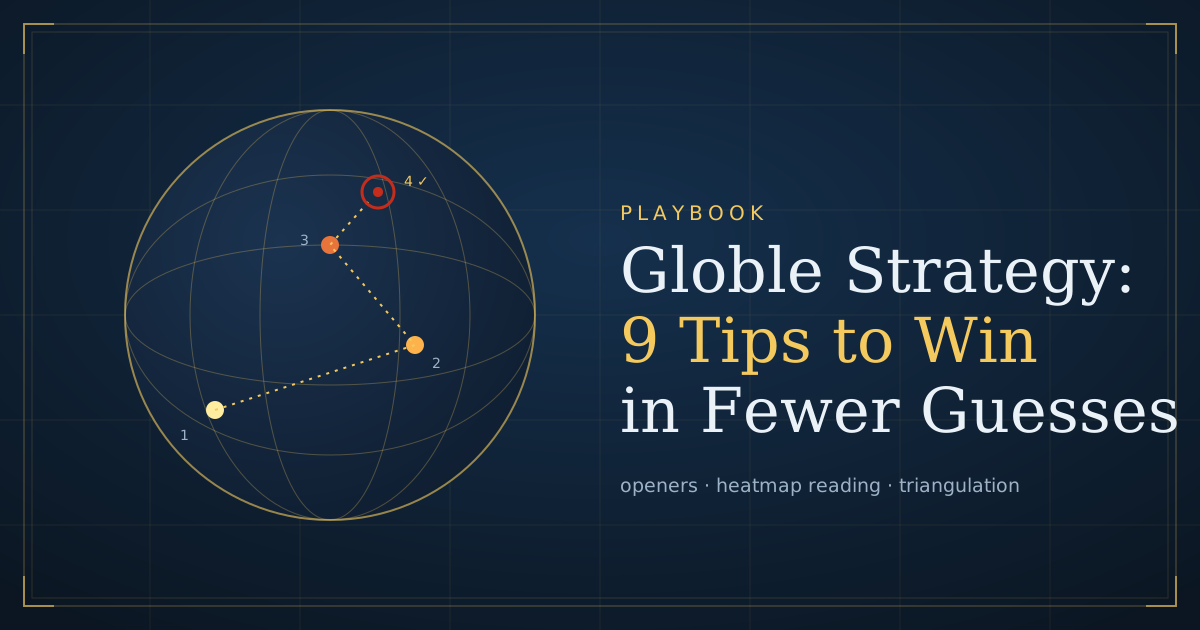
Globle looks simple — type a country, read the colour, repeat — but the gap between a lucky fifteen-guess round and a clean four-guess solve comes down to strategy. This guide shares nine tips that consistently lower your guess count, from the best opening moves to the subtle art of reading the heatmap. If you are brand new, skim the how-to-play guide first, then come back here to sharpen up.
Everything below is easier to practise when you are not rationed to one puzzle a day, which is why we recommend running a few rounds of Globle Unlimited alongside this article. Learning is repetition, and unlimited mode gives you all the repetitions you want.
1. Open with a large, central country
Your first guess should gather the most information, and big central countries do exactly that. Because they border or sit near so many others, the colour you get back meaningfully narrows the search no matter where the answer hides. Strong openers include:
- Kazakhstan — enormous and central to Eurasia.
- Algeria or Sudan — anchor the African landmass.
- Brazil — dominates South America.
- China or India — cover dense, populous Asia.
A single central opener usually tells you which third of the planet to focus on.
2. Probe a second continent immediately
If your first guess comes back cold (pale yellow), do not keep poking nearby. Jump to a different continent for your second guess. Two well-separated openers — say, Brazil and Kazakhstan — give you a rough triangulation on the very first exchange, so by guess three you are already in the right region.
3. Read colour as a compass, not a coordinate
The heatmap tells you direction and nearness, not an exact spot. A deep-red country says “the answer is in my neighbourhood”; a pale one says “look elsewhere.” Resist the urge to treat one warm country as the answer. Instead, use warm and cool guesses to bracket the target from both sides.
4. Trust the kilometre reading over the colour
Colour is coarse; the closest-border distance in kilometres is precise. When two guesses look similarly warm, the number breaks the tie. Watch how it moves: a sharp drop means you are heading the right way, a rise means reverse course. Pair the two signals and you rarely waste a guess.
5. Triangulate, do not wander
Good Globle players think like surveyors. Once you have one warm country, guess a neighbour on each side of it. Each result tightens the box around the answer. Three deliberate triangulating guesses beat ten hopeful ones every time.
6. Remember the small countries
The mystery country is just as likely to be tiny as huge. When the heat gets hot around a cluster of small nations — the Gulf states, the Balkans, Central America, West Africa — zoom in and test them one by one. Players lose more rounds to overlooked micro-states than to anything else.
7. Learn the notorious neighbours
A handful of regions trip everyone up because the countries are packed tightly: the Balkans, the Caucasus, the Horn of Africa, Southeast Asia’s mainland, and the Gulf. Spend a few practice rounds deliberately guessing in these clusters. Once you know that Armenia, Georgia and Azerbaijan sit shoulder to shoulder, hot colours there stop being confusing.
8. Use the globe, not a flat map mindset
Globle is a sphere, and distances wrap. Russia’s east is close to Alaska; the southern tips of South America, Africa and Australia are nearer each other than a flat map suggests. Drag and rotate the globe so you are judging real great-circle distance, not the distorted picture a 2D map puts in your head.
9. Keep a mental “first guess” routine
Consistency compounds. If you always open the same way — one central Old World country, one in the Americas — you build an instinct for what each colour pattern means. Over a week of unlimited practice, that routine alone will shave guesses off your average.
Putting it together: a sample round
Suppose your opener, Brazil, comes back cold. You switch hemispheres and guess Kazakhstan, which glows orange — warmer. The kilometre reading says about 4,000 km. You triangulate with India (hotter) and China (hotter still, deep red). Now you zoom into East Asia, test South Korea and Japan, and the deep red on Japan’s neighbours tells you the answer is right there. Five guesses, no luck required — just method.
Common mistakes that cost guesses
- Chasing one warm country too long instead of testing its neighbours.
- Ignoring the distance number and going on colour alone.
- Forgetting small nations when the heat spikes.
- Thinking flat on a round globe, which misjudges polar and trans-ocean distances.
Keep practising
Strategy only sticks with reps. Run a handful of Globle Unlimited rounds whenever you have a spare minute, try the shared daily challenge to benchmark yourself, and when you are stuck, the today’s answer page is there as a safety net. Play often enough and the four-guess solve stops being luck and starts being your normal.
Frequently asked questions
What is the best first guess in Globle? A large, central country such as Kazakhstan, Brazil, Algeria or China. They sit near many others, so the colour you get back narrows the search quickly.
How many guesses is a good Globle score? Most strong players solve in roughly five to six guesses on average. With deliberate triangulation and good openers, three- and four-guess solves become common.