

Home › How to Play
How to Play Globle Unlimited
Globle is a country-guessing game played on a 3D globe. Every round hides one mystery country, and your job is to find it in as few guesses as possible using nothing but geography and a colour-coded distance heatmap. This guide covers the rules, how the colours work, and the strategies that cut your guess count.
The Goal of Globle
The goal is to identify the hidden mystery country using the fewest guesses. There is no time limit and no penalty for guessing, so the only score that matters is how efficiently you close in. In Globle Unlimited you can do this over and over with a new random country every round; in the daily challenge everyone hunts the same country on the same day.
Step-by-Step: How to Play
- Type any country into the box and press Enter to make your first guess.
- Watch it light up on the globe. The colour tells you how close that country is to the mystery country.
- Read the distance. The panel shows your closest country so far and the distance to the mystery country’s border, in kilometres.
- Guess toward the heat. Pick your next country in the direction of the hottest colours you’ve revealed.
- Find it. When you guess the exact country, it flashes green and the round is solved.
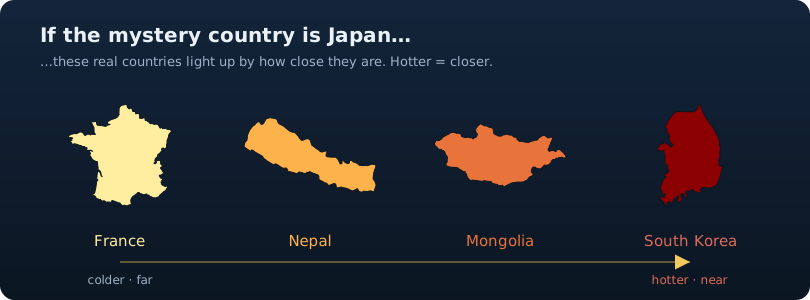
Understanding the Colour Heatmap
The heatmap is the heart of Globle. Each guess is shaded by how far its centre sits from the mystery country’s centre. The scale runs from pale yellow for the most distant guesses to deep red for guesses that are almost on top of the answer.
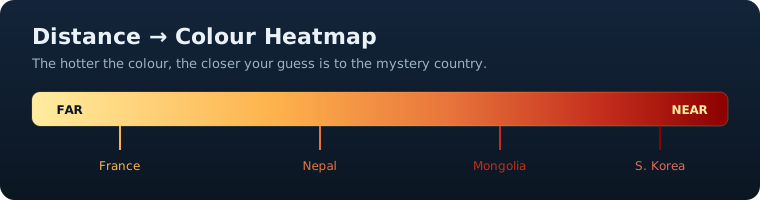
Treat colour as a compass, not a coordinate. A deep-red country tells you the answer is in its neighbourhood; a pale-yellow one tells you to look on the other side of the map. By sandwiching the answer between warm and cool guesses, you triangulate the mystery country quickly.
Reading “Closest” & “Closest Border”
Below the globe, Globle shows your closest country so far and the closest-border distance in kilometres. That number is your single best progress signal: when it drops sharply after a guess, you are moving the right way; when it climbs, back off and try the opposite direction. Use it together with the colours rather than on its own.
Best Opening Guess Strategy
A strong first guess covers as much of the map as possible. Large, central countries make the best openers because they sit near many others and give you a clear heat reading no matter where the answer hides. Good choices include:
Reliable opening countries
- Kazakhstan — huge and central to Eurasia.
- Algeria or Sudan — anchor the African landmass.
- Brazil — dominates South America.
- China or India — cover dense, populous Asia.
Open with one country from a couple of different continents and the heat colours will point you to the right region within two or three guesses. For a deeper playbook, read our Globle tips and strategy guide.
Common Mistakes to Avoid
- Chasing one warm country too long. A red guess narrows the region, but you still need to test its neighbours to find the exact answer.
- Ignoring the distance number. Colour is coarse; the kilometre reading is precise. Use both.
- Forgetting small nations. The answer can be a tiny country tucked beside a big one, so zoom in when the heat gets hot.
Globle Unlimited vs the Daily Globle
If you enjoy practising, Globle Unlimited gives you endless rounds with no waiting. When you want the shared challenge, the daily Globle hides one country for everyone each day, and a practice mode lets you warm up without touching your streak. Stuck on today’s puzzle? Check the today’s Globle Unlimited answer.
Frequently Asked Questions
Is there a time limit in Globle?
No. There is no timer — take as long as you like and guess as many times as you need.
What counts as a correct guess?
You win when you type the exact mystery country. Common spellings and aliases (like USA for the United States) are accepted.
How does the colour work?
Each guessed country is shaded by its distance to the mystery country: pale yellow is far, deep red is very close.
Does Globle work on mobile?
Yes. Drag to rotate and pinch to zoom the globe on any phone or tablet, right in the browser.