

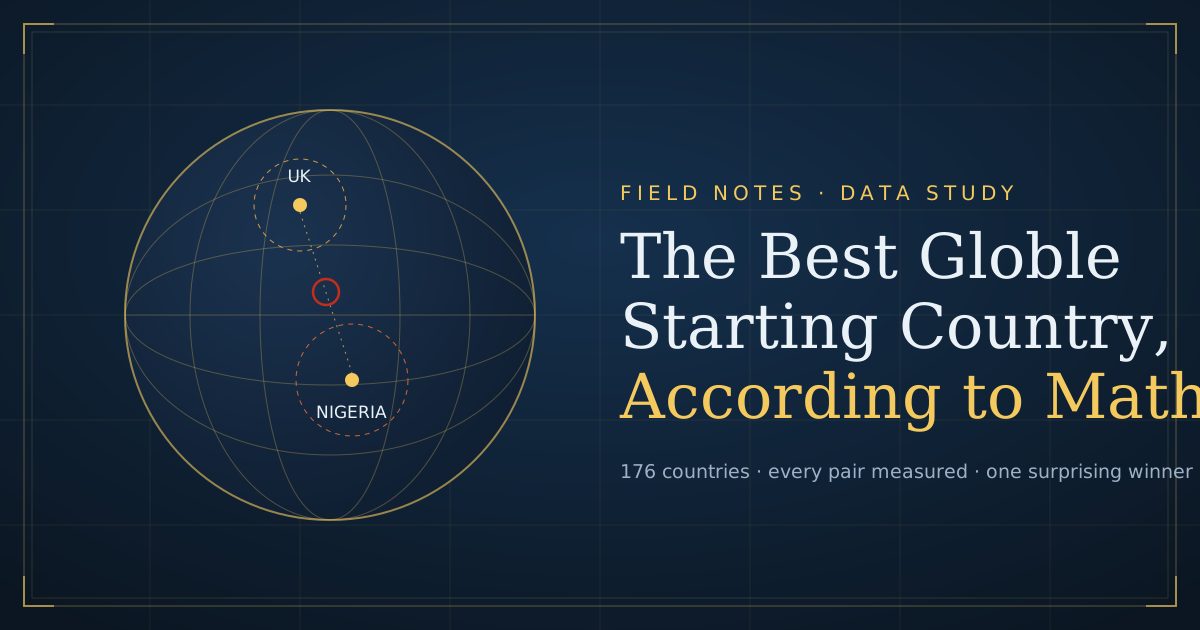
Ask any Globle regular for their opening guess and you will hear the same short list: Kazakhstan, Russia, Egypt, Algeria. Big, central, touches everything — what could be better?
Quite a lot, it turns out. We took the 176-country dataset that powers Globle Unlimited, measured the great-circle distance between every pair of countries — 15,400 pairs in total — and scored every possible opening guess two different ways. The conventional wisdom did not survive contact with the data: Russia ranks 168th out of 176 openers, Egypt 164th, and Kazakhstan a middling 128th on the measure that actually wins games.
This article shows the full rankings, explains why the popular picks underperform, and gives you a two-guess opening that narrows the entire world to about four candidate countries. Here is what you’ll learn:
- Why “central” and “informative” are two different properties of an opener
- The most central country on Earth (it is not in Asia)
- The sharpest single openers — and the mathematically best two-guess pair
- How to actually use these numbers in your next daily
What makes a good opening guess?
A good Globle opener is a country whose colour feedback eliminates the largest number of candidate answers. Globle tells you only one thing per guess: a colour that encodes how far your guess is from the mystery country. Pale yellow means thousands of kilometres away; deep red means you are practically touching it. A strong opener converts that single colour into the smallest possible list of remaining suspects.
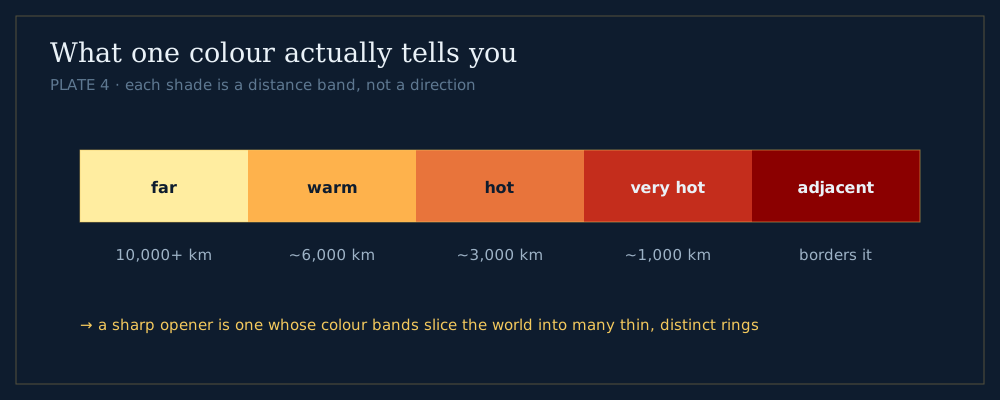 Plate 4 — one guess gives you a distance band, not a direction. The opener decides how thin that band is.
Think of each colour as a ring drawn around your guess: “the answer is roughly this far from me.” The question that separates good openers from bad ones is: how many countries sit inside the same ring? If dozens of countries are all about 4,000 km from your opener, then hearing “about 4,000 km” barely helps you. If only a handful are, that same colour is devastatingly informative.
That framing gives us two measurable properties:
- Centrality — how close a country is, on average, to all the others. Central countries get “hot” feedback more often, which feels good.
- Discrimination — how thinly a country’s distance rings slice the world. Discriminating countries produce feedback that few candidates can share, which is good.
The popular advice optimises the first property. Winning optimises the second. They are not the same thing — and for some famous openers they point in opposite directions.
How we measured it
No survey, no vibes: we computed it. The method, in full, so you can replicate it:
- Dataset: the same 176 countries used by Globle Unlimited, each with a centre-point latitude and longitude (derived from Natural Earth data).
- Distance: the haversine formula on those centre points, Earth radius 6,371 km — the same calculation the game itself uses to colour your guesses. That yields a 176 × 176 distance matrix: 15,400 unique country pairs.
- Centrality score: for each country, the mean distance to the other 175. Lower is more central.
- Discrimination score: for each country, we asked — averaged over every possible mystery country — how many other countries lie within ±500 km of the answer’s distance? That ±500 km band approximates what you can realistically read from one colour shade. Lower means the opener’s feedback is harder to confuse, i.e. sharper.
- Pair score: the same test applied to two openers at once — a candidate survives only if it matches both distance bands.
📝 Note: ±500 km is a deliberately generous read of the colour scale. We re-ran the study at ±300 km and ±700 km and the rankings barely moved — the winners and losers below are robust to how precisely you read colours.
The centrality ranking: the world’s middle is the Balkans
First, the property everyone talks about. Which country is closest, on average, to everything else?
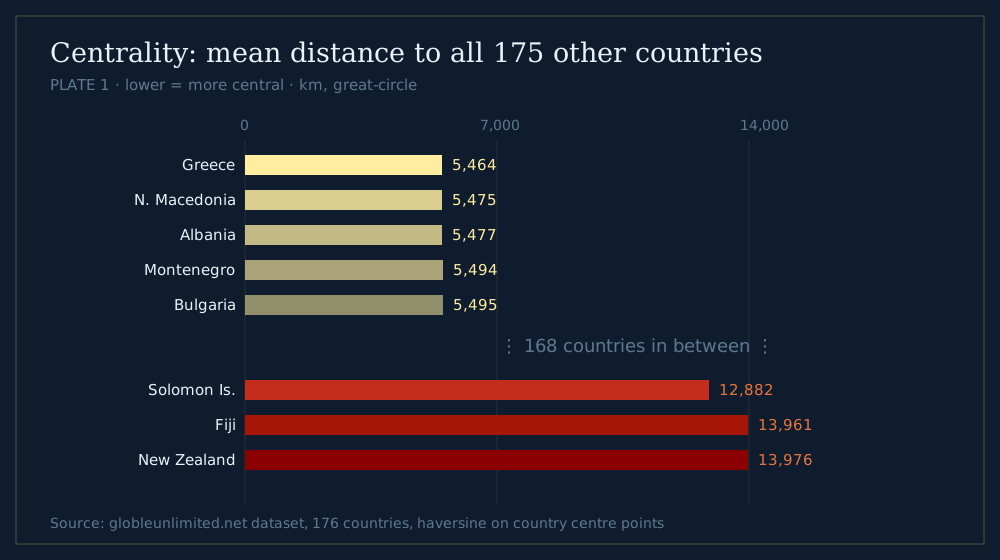 Plate 1 — mean great-circle distance from each country to the other 175.
Greece is the most central country in the world, a mean of 5,464 km from the other 175 countries in the dataset. The entire top ten is a Balkan and eastern-Mediterranean cluster: North Macedonia (5,475 km), Albania (5,477 km), Kosovo (5,485 km), Montenegro (5,494 km), Bulgaria (5,495 km). This is not mysterious — the majority of the world’s countries are packed into Europe, Africa and Asia, and the eastern Mediterranean sits at the hinge of all three.
At the other end, New Zealand is the least central country on Earth: on average 13,976 km — more than a quarter of the planet’s circumference — from everywhere else. Fiji, New Caledonia, Vanuatu and the Solomon Islands fill out the bottom five. If you have ever opened with New Zealand “to rule out the Pacific,” you paid a full guess for information a pale-yellow Kazakhstan would have given you for free.
The centrality table also produces our favourite single statistic of the study: the farthest two countries in the dataset are Paraguay and Taiwan, 19,932 km apart — almost exactly antipodal. If you ever guess Paraguay and see the palest possible yellow, you can practically type Taiwan.
The discrimination ranking: where the upset happens
Now the property that wins games. Which opener’s colour bands slice the world most thinly?
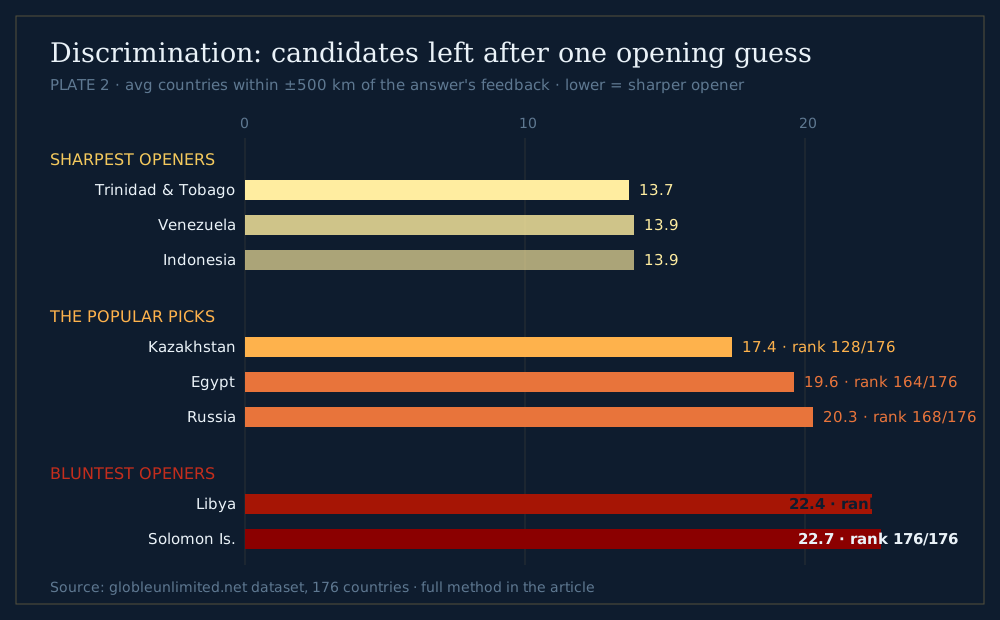 Plate 2 — average number of candidate countries left within ±500 km of the answer’s feedback.
The sharpest single opener in Globle is Trinidad and Tobago, leaving an average of just 13.7 candidate countries after one guess. Venezuela, Indonesia and Suriname (13.9 each), Guyana (14.0) and Timor-Leste (14.0) crowd right behind it.
And the household names? Kazakhstan leaves 17.4 candidates (rank 128 of 176), Egypt 19.6 (rank 164), and Russia 20.3 (rank 168). The very worst openers on Earth are Libya at 22.4 (rank 175) and the Solomon Islands at 22.7 (dead last) — with Chad, Liberia and Sierra Leone close by. An opening guess of Trinidad and Tobago eliminates, on average, nine more countries than an opening guess of Russia.
Why the popular picks underperform
The pattern in the losers’ bracket is striking: Libya, Chad, Egypt, Algeria — the exact “big central desert country” archetype the standard advice recommends. Why do they fail?
Because being in the middle of everything means everything is at a similar distance from you. Sit in the Sahara and enormous numbers of countries — most of Europe, the Middle East, half of Africa — fall into the same handful of distance bands. Your “informative” central position actually manufactures ties: dozens of candidates that your one colour cannot tell apart.
The winners sit differently. Trinidad, Venezuela, the Guianas: close to a dense continent on one side, with the rest of the world spread smoothly across the distance spectrum on the other. Their rings are thin almost everywhere, so nearly every colour they return is specific.
💡 Pro tip: centrality still has one real virtue — comfort. A central opener gets you “warm” colours early, which are easier to reason about than a wall of pale yellow. If you find the edge-of-the-map openers disorienting, France (15.5) and China (14.9) rank in the top third on discrimination and stay pleasantly central. Brazil, the one classic pick the data respects, scores 15.0 — rank 25 of 176.
The best two-guess openings
One guess only starts the squeeze. The real power move is a fixed pair of openers whose rings cross cleanly. We scored every pair drawn from the sixty most central countries — roughly 1,800 pairs — on the same test: how many candidates survive both distance bands?
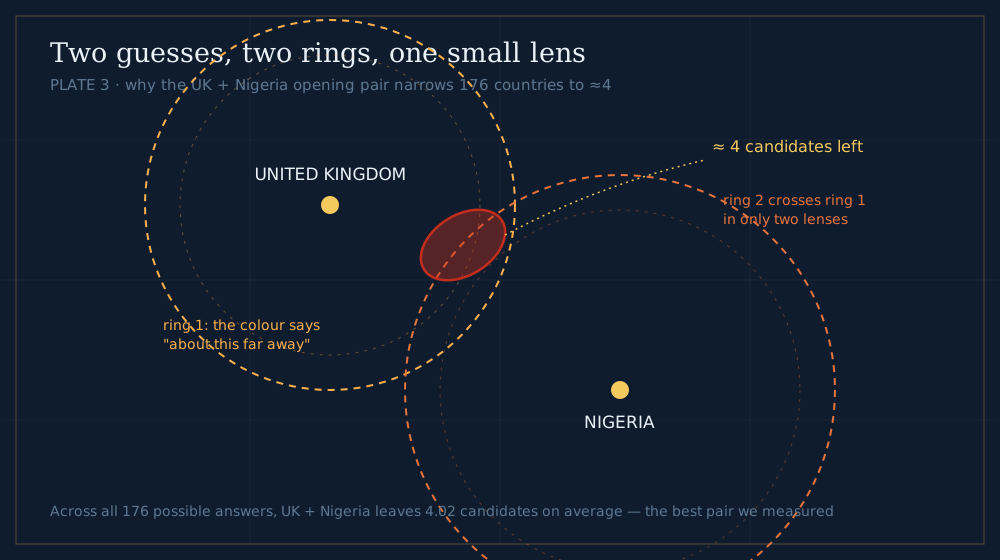 Plate 3 — two well-placed rings intersect in a small lens. UK + Nigeria leaves 4.02 candidates on average.
The best opening pair we measured is the United Kingdom followed by Nigeria: across all 176 possible answers, it narrows the field to 4.02 candidate countries on average. The runners-up tell the same story with different accents:
| Opening pair | Avg candidates left |
|---|---|
| United Kingdom + Nigeria | 4.02 |
| France + Nigeria | 4.24 |
| France + South Sudan | 4.28 |
| Portugal + Central African Republic | 4.31 |
| Belgium + Nigeria | 4.36 |
| Spain + Nigeria | 4.39 |
Every elite pair combines one north-west European country with one central African country — two anchors roughly 5,000–6,000 km apart (the UK averages 6,100 km from everywhere; Nigeria, 6,149 km), offset both north–south and east–west. Their rings meet at a steep angle, so the intersection lens is tiny. Two guesses in, you are choosing between a handful of countries; with decent geography, guess three or four closes the game.
Notice what is not on the list: no Kazakhstan, no Russia, no antipodal “one guess per hemisphere” combos. Maximum spread produces rings so large they intersect in fat, sloppy lenses. Optimal is offset, not opposite.
💡 Pro tip: the pair is stronger than the sum of its parts. Nigeria alone ranks a poor 19.0 on single-guess discrimination — but as a second ring against the UK’s, it is the best follow-up on Earth. Openers are a team sport.
Putting it into practice
A ranking is not a strategy. Here is the playable version:
- Adopt a fixed opening. UK → Nigeria if you want the measured optimum; France → Nigeria if you prefer a continental anchor. Playing the same opening every day builds the pattern memory that makes colours meaningful.
- Read the first colour before firing the second guess. The pair works because the rings cross — but if the UK comes back deep red, abandon the script and hunt in Europe immediately. The numbers above assume you use your eyes.
- After two guesses, list your lens. Ask: which countries are about this far from the UK and about that far from Nigeria? There will usually be three to five. Pick the one whose neighbours would best split the remainder.
- Drill it where repetition is free. One puzzle a day is a slow classroom. Run the opening ten times in unlimited mode, or replay specific regions in practice mode, and the lens-listing step becomes automatic. Our strategy guide covers the mid-game squeeze from there.
For calibration on the hard tail — the microstates and lookalike islands that survive even a perfect opening — see our list of the hardest countries to guess in Globle.
What the study can’t tell you
Honest data journalism names its own limits, so here are ours — and they matter for how you use the rankings.
Centre points, not borders. Our distances run between country centre points, which is how Globle Unlimited colours its map. Games that measure to the nearest border — so a guess of Russia glows red for anything touching Russia’s enormous frontier — shift the math for giant countries: border-distance rules make Russia’s feedback less specific still (fourteen neighbours all read “adjacent”), which strengthens rather than weakens our conclusion about oversized openers.
Dataset edges. We score 176 countries; other implementations include a handful more territories or fewer microstates. Spot checks suggest adding or removing microstates barely moves the rankings — microstates sit next to big neighbours and inherit their distance profile — but the third decimal place of any score is noise, and we treat it that way.
Uniform answers. The model assumes every country is equally likely to be the day’s answer. If a game’s answer pool over-weights famous countries, openers near the famous clusters gain a little value. We have no evidence of such weighting, and modelling rumours would be worse than modelling uniformity.
Humans aren’t bandwidth-free. The ±500 km band assumes you can read one colour into one distance ring reliably. Beginners can’t, yet — which is a real argument for starting your career with comfortable central openers like France and graduating to the optimum pair once colour reading is automatic. The math tells you where the ceiling is; it doesn’t climb the stairs for you.
None of these caveats rescues the conventional wisdom, though. Under every variant we tested, the ranking’s headline survives: thin rings beat warm feelings, and the Sahara-sized “obvious” openers are measurably the weakest choices in the game.
Frequently asked questions
What is the best starting country in Globle?
By measured information gain, Trinidad and Tobago is the single sharpest opener, leaving an average of 13.7 candidate countries out of 176 after one guess. Among familiar large countries, China (14.9) and Brazil (15.0) score best. The strongest fixed two-guess opening is the United Kingdom followed by Nigeria, which narrows the field to about 4 candidates on average.
Is Kazakhstan actually a good Globle opener?
It is mediocre. In our 176-country study Kazakhstan ranks 128th of 176 on discrimination, leaving 17.4 candidates on average — nearly four more than Trinidad and Tobago. Its reputation comes from centrality and size, which feel informative but create many distance ties across Europe and Asia.
What is the most central country in the world?
Greece, by mean distance to other countries: 5,464 km on average to each of the other 175 countries in our dataset. The top six most central countries are all in the Balkans and eastern Mediterranean. The least central is New Zealand, averaging 13,976 km from everywhere else.
How was this study calculated?
We used the haversine formula (Earth radius 6,371 km) on the centre points of the 176 countries in Globle Unlimited's dataset — 15,400 country pairs. An opener's score is the average number of other countries lying within ±500 km of the true answer's distance, taken over every possible answer; opener pairs require a candidate to match both bands. Rankings were stable when we varied the band from ±300 km to ±700 km.
Does the best opener change in other game modes?
The logic transfers but the geography changes. In Capitals mode distances run between capital cities, which shifts the rankings slightly; in States mode the field is only 50 answers, so a central opener like Kansas carries more of the load. The principle — prefer thin rings over warm feelings — holds everywhere.
Method note: analysis run July 2026 on Globle Unlimited’s 176-country dataset (centre points derived from Natural Earth). We build and maintain the seven geography games on this site and the dataset behind them. Found something we missed? Tell us — we’ll re-run the numbers.